

In today’s fast-paced digital world, content is king, but clarity is the crown. You can have the most insightful research or the most detailed product description, but if your audience can’t easily read and digest it, your content will fail. This is why mastering your readability score is the single most critical step you can take to boost your SEO, reduce bounce rates, and increase conversions.
This comprehensive guide will answer the most common long-tail questions users ask—such as “how to instantly improve readability score” and “what is a good Flesch-Kincaid score for a blog”—and show you exactly how to use our dedicated Readability Scorer Tool at https://imageconverthq.com/readability-scorer/ to achieve crystal-clear text clarity.
Part I: Understanding Why Your Readability Score Matters
Before we dive into the “how-to,” let’s solidify the “why.” Why are search engines and modern content strategists obsessed with the readability score?
Why Should I Care About Readability Score for SEO?
Google’s primary mission is to deliver the best possible experience to its users. If a user clicks on your link and finds the content overly complex or dense, they quickly bounce back to the search results. This “pogo-sticking” signals poor quality to Google.
A high readability score directly impacts these critical SEO signals:
- Reduced Bounce Rate: Clear, simple text is easier to process, encouraging users to stay on the page longer.
- Increased Dwell Time: When content is easy to read, users spend more time consuming it, a major positive ranking factor.
- Topical Authority: Communicating complex ideas with high text clarity demonstrates mastery, which aligns perfectly with Google’s E-A-T (Expertise, Authoritativeness, Trustworthiness) criteria.
What is the Flesch-Kincaid Formula and Why is it the Standard?
The Flesch-Kincaid formula is the gold standard for measuring text clarity. It is trusted because it is objective and mathematically sound, relying on two key factors:
- Average Sentence Length (ASL): Longer sentences reduce your score.
- Average Syllables per Word (ASW): Longer words (polysyllabic words) reduce your score.
By combining these, the Readability Scorer gives you a Flesch Reading Ease score (0–100) or a Grade Level score.
Part II: What is a Good Flesch-Kincaid Score for a Blog or Website?
This is one of the most frequently asked questions. The ideal target score depends heavily on your audience, but for general web content, there is a clear benchmark.
| Flesch Reading Ease Score | Grade Level Equivalent | Interpretation | Recommended Content Type |
| 90 – 100 | 5th Grade | Very Easy. Simple, conversational, and direct. | FAQs, Product Descriptions, Short Social Media Captions. |
| 80 – 90 | 6th Grade | Easy. Perfect for broad consumer audiences. | General Blog Posts, Email Newsletters. |
| 70 – 80 | 7th Grade | Fairly Easy. Engaging and suitable for most popular websites. | Target Zone for most blogs and B2C content. |
| 60 – 70 | 8th to 9th Grade | Standard. Easily understood by teenagers. | News articles, Standard technical content. |
| 50 – 60 | 10th to 12th Grade | Fairly Difficult. Best for specialized, educated audiences. | Industry reports, White papers. |
The Actionable Goal: When using our Readability Scorer Tool, aim for a minimum Flesch-Kincaid score of 65 for broad SEO success. This ensures your text clarity meets the ‘Fairly Easy’ standard.
Part III: How to Instantly Improve Readability Score in 5 Actionable Steps
You don’t need a literature degree to fix your content. Our Readability Scorer provides the diagnosis; these five steps are the cure. By focusing on these principles, you will see your Flesch-Kincaid score jump dramatically.
Step 1: Divide and Conquer Long Sentences (The ASL Fix)
Long sentences are the number one culprit behind a low readability score. Readers lose track of the main idea, resulting in confusion and a quick exit from your page.
The Fix: Use our Readability Scorer Tool to identify paragraphs with a high Average Sentence Length (ASL). Whenever you encounter a sentence over 20 words, break it into two or three distinct sentences.
- Before (Low Score): “The corporate strategy meeting, which spanned four contentious hours, ultimately resulted in the board making a decision to permanently cease all manufacturing operations and pivot entirely to digital sales.” (32 words)
- After (High Score): “The corporate strategy meeting spanned four contentious hours. The board finally made a decision. They will permanently cease all manufacturing operations and pivot entirely to digital sales.” (30 words, 3 sentences. ASL is 10.)
Step 2: Swap Complex Words for Simple Synonyms (The ASW Fix)
The Flesch-Kincaid formula actively penalizes polysyllabic words (three or more syllables). Using simpler, everyday vocabulary dramatically increases text clarity.
The Fix: Review your text for polysyllabic words identified by the Readability Scorer. Don’t ‘dumb down’ your topic, just simplify your delivery.
| Complex Word (Low Score) | Simple Word (High Score) |
| Utilize (4 syllables) | Use (1 syllable) |
| Demonstrate (4 syllables) | Show (1 syllable) |
| Commence (2 syllables) | Start or Begin (1-2 syllables) |
| Facilitate (4 syllables) | Help (1 syllable) |
| Subsequent (3 syllables) | Next (1 syllable) |
Step 3: Implement Clear Visual Structure (For Engagement)
While purely visual structure doesn’t affect the mathematical Flesch-Kincaid score, it drastically improves the perception of text clarity and scannability, which boosts those vital SEO user signals (dwell time).
The Fix:
- Use Subheadings: Break up your content every 2-3 paragraphs. Subheadings should be descriptive and include secondary keywords.
- Use Lists and Bullet Points: Convert any list of three or more items into bullet points. This allows readers to scan and absorb information instantly.
- Short Paragraphs: Limit paragraphs to 3-4 sentences maximum. On mobile screens, long paragraphs look like imposing “walls of text.”
Step 4: Prioritize the Active Voice
The passive voice often adds unnecessary words and confuses the subject of the sentence, thereby increasing your ASL unnecessarily. Active voice is direct and promotes better text clarity.
The Fix: Write sentences where the subject performs the action.
- Passive (Low Score): The report was written by the financial analyst. (7 words)
- Active (High Score): The financial analyst wrote the report. (6 words)
Step 5: Check Your Score on Multiple Formulas
Don’t rely solely on the Flesch-Kincaid score. A robust readability scorer should offer multiple formulas (like our free tool does!). Checking the Gunning Fog Index or the SMOG index provides a more holistic view of your text clarity.
- If Gunning Fog is high: You need to reduce your density of complex, three-syllable words.
- If SMOG is high: Your content is too dense for non-expert readers.
Part IV: How to Use Our FREE Readability Scorer Tool (Step-by-Step)
Why pay for expensive writing software when you can access a powerful, free Readability Scorer Tool online? Our tool is designed to give you instant, accurate feedback on your text clarity based on the Flesch-Kincaid system.
Follow these simple steps to analyze your content now:
➡️ Click Here to Try the FREE Readability Scorer Tool: https://imageconverthq.com/readability-scorer/
Step 1: Copy Your Text
Open the blog post, email, or report you want to analyze and copy the entire block of text.
Step 2: Paste into the Scorer
Navigate to the Readability Scorer Tool at https://imageconverthq.com/readability-scorer/. Paste your copied text into the large text analysis box.
Step 3: Click “Analyze Score”
Hit the Analyze Score button. The tool instantly runs the mathematical calculations of the Flesch-Kincaid formula on your text.
Step 4: Interpret the Flesch-Kincaid Results
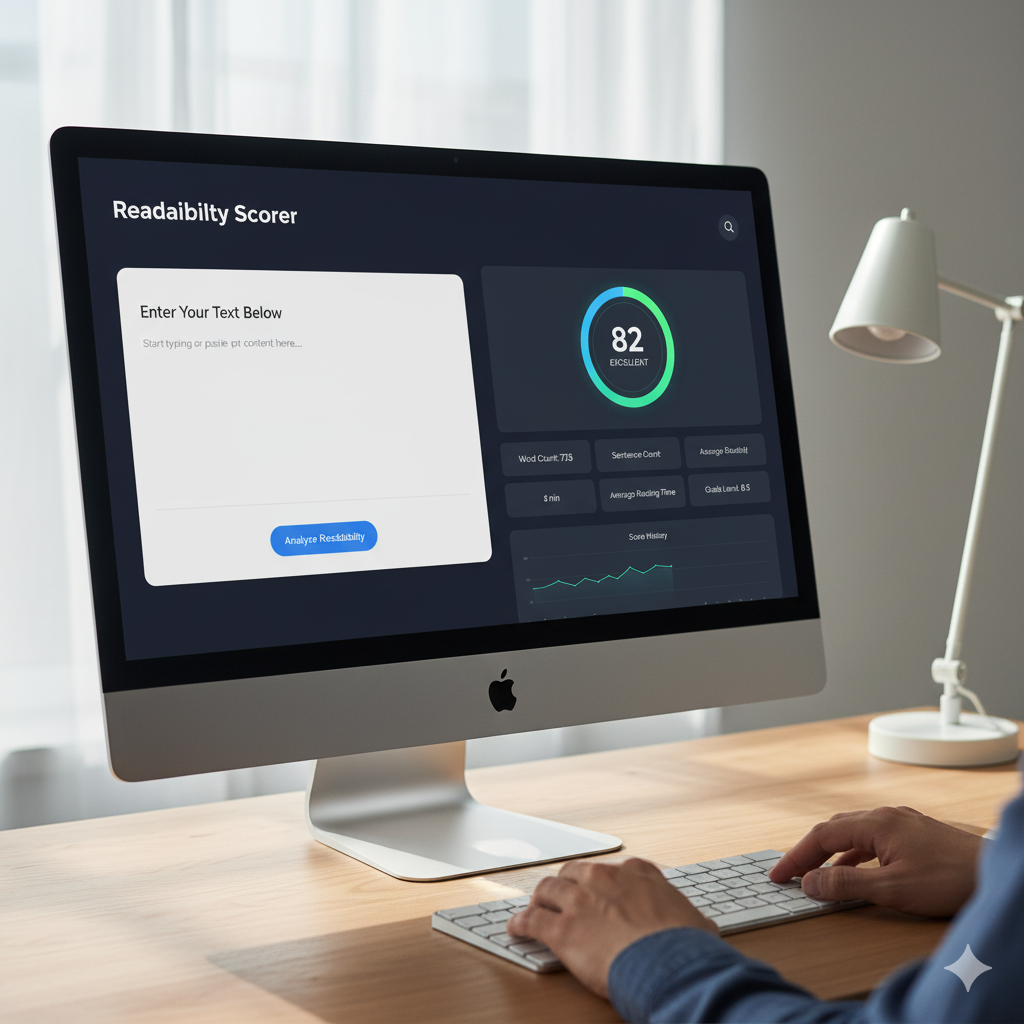
The tool will display three key outputs:
- Readability Score (0-100): This is your main Flesch Reading Ease score. Remember, aim for 65+.
- Grade Level Interpretation: This gives you the equivalent US school grade level required to understand the text.
- Metrics: Check your Total Words, Total Sentences, and crucial Avg. Words Per Sentence metric.
Step 5: Edit and Re-Test for Max Clarity
If your score is below 65, go back to your text and apply the 5 Actionable Steps (Part III) we discussed: shorten sentences, simplify complex words, and use active voice.
After editing, paste the revised text back into the Readability Scorer Tool and watch your score improve! Repeat this cycle until you reach your target score. This process guarantees maximum text clarity and engagement.
Part V: Long-Tail Q&A – Solving Common Readability Challenges
To provide comprehensive value, let’s address some of the detailed, long-tail questions users often search for when trying to improve their content clarity.
How Does Readability Scorer Check Text Clarity for Technical Writing?
Technical writing must convey complex information accurately, often resulting in a low readability score. For technical content, the goal isn’t to reach a 7th-grade level, but to increase text clarity relative to your expert audience.
Recommendation: Aim for a Flesch-Kincaid score in the 40–50 range. Use the tool to minimize ASL (short, focused sentences) but accept a higher ASW (longer, technical words) where necessary. Always define technical terms early on.
Is My Readability Score Different for Mobile vs. Desktop?
The calculated readability score (the Flesch-Kincaid number) is mathematically the same regardless of the device. However, the perceived text clarity is much lower on mobile.
The Mobile Fix: Since long paragraphs look overwhelming on a narrow mobile screen, strictly limit paragraphs to 2–3 sentences maximum. This visual spacing complements your high readability score achieved with our tool.
What’s the Best Readability Checker for Students?
For students, the Flesch-Kincaid Grade Level is most useful as it directly correlates with their academic level. Our Readability Scorer Tool is perfect for students because it is free, instant, and provides the Grade Level output alongside the Ease Score, allowing them to instantly see if their paper matches the required academic standard.
Can a High Readability Score Ever Be Bad?
Yes. If you are writing for a journal, a highly specialized academic paper, or legal documentation, a very high score (90+) might indicate that your writing is too simplistic and lacks the necessary professional depth or precision. For these specific formats, a moderate score (30–50) is expected. For almost all web content, however, a high score is a positive.
Take Control of Your Content Quality
Your readability score is the silent metric that determines your content’s success in the modern search landscape. By focusing on improving text clarity using the proven principles of the Flesch-Kincaid formula, you are investing directly in better SEO, superior user experience, and higher conversion rates.
Don’t guess—measure! Take control of your content quality today by running your next article through our powerful and free Readability Scorer Tool.
➡️ Improve Your Flesch-Kincaid Score Now: https://imageconverthq.com/readability-scorer/
No responses yet