


The Ultimate Guide to the Readability Scorer: Master Flesch-Kincaid for Better Content and SEO
In the world of digital content, speed, visual appeal, and technical SEO often dominate the discussion. But there is one crucial factor that determines whether a user stays on your page, understands your message, and converts: readability.
A beautifully designed website with technically perfect SEO tags is useless if the content is an academic paper that your average reader struggles to consume. This is where the Readability Scorer becomes the most powerful weapon in your content arsenal.
This guide will take a deep dive into what a Readability Scorer is, why it is essential for modern SEO, how the famous Flesch-Kincaid formula works, and how you can use this tool today to boost your text clarity and content authority.
What Exactly is a Readability Scorer?
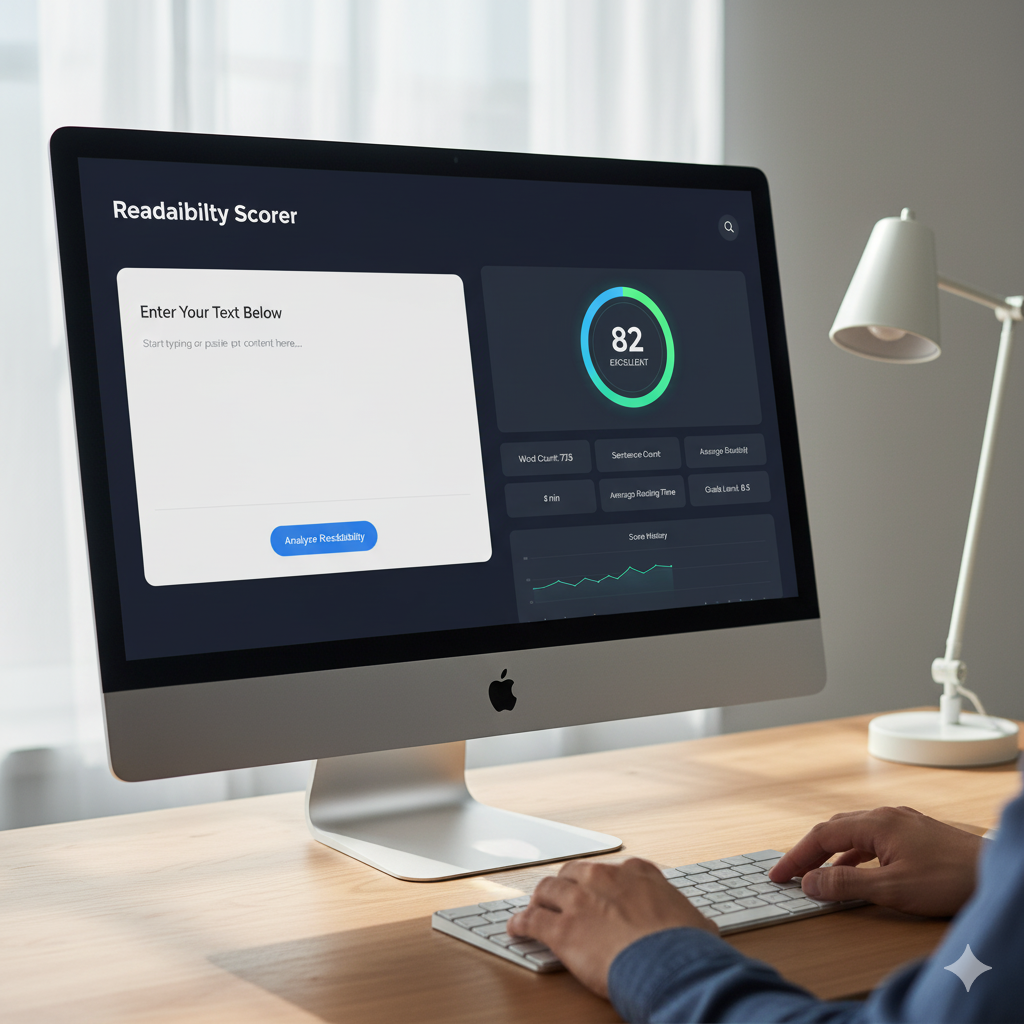
A readability scorer is a tool that analyzes a piece of text and assigns it a numerical score based on its complexity. This score attempts to predict the level of education (or reading proficiency) a person would need to easily understand that text.
Unlike simple grammar checkers, a readability scorer doesn’t care if you used a semicolon incorrectly; it focuses on structural and linguistic complexity, primarily measuring:
- Sentence Length: How many words are in the average sentence?
- Word Complexity: How many syllables are in the average word?
By combining these factors, the tool gives you an objective measure of your text clarity.
Readability vs. Grammar: Making the Distinction
Many writers confuse the goals of readability and grammar. They are distinct but equally important:
- Grammar ensures correctness (e.g., proper subject-verb agreement, tense, and punctuation).
- Readability ensures accessibility (e.g., making complex ideas simple, breaking up dense paragraphs, and choosing accessible vocabulary).
A text can have perfect grammar but still score poorly on a readability scorer if it’s filled with long, convoluted sentences and polysyllabic words. Conversely, an easy-to-read text should always aim for correct grammar, but its primary goal is high text clarity.
Deep Dive into the Flesch-Kincaid Formula
While there are dozens of readability formulas, Flesch-Kincaid is by far the most recognized, particularly because it is the standard used by popular platforms and writing software.
The Flesch-Kincaid testing has two primary scales that are derived from the same mathematical foundation:
1. The Flesch Reading Ease Score (0–100 Scale)
This is the most common score displayed by a readability scorer. It operates on a 0 to 100 scale, where the score directly correlates with the ease of reading.
- 90 – 100 (Very Easy): Easily understood by the average 5th-grade student. Suitable for consumer products, general blog posts, and comics.
- 60 – 70 (Standard): Easily understood by 10th- to 12th-grade students. This is the sweet spot for the vast majority of web content, including most serious blogs and news reporting.
- 30 – 50 (Difficult): Understood by college graduates. Suitable for academic papers, legal documents, and highly specialized technical content.
- 0 – 30 (Very Difficult): Best reserved for highly specialized research or legal language.
Goal: For web and blog content aimed at a general audience, always aim for a Flesch-Kincaid score of 60 or higher.
2. The Flesch-Kincaid Grade Level (Education Scale)
This score translates the text’s complexity into a U.S. school grade level. A score of 8.0, for example, means an average 8th-grade student can understand the text.
This scale is useful for content strategists targeting a specific demographic:
- If you are writing content for the general public (B2C), aim for a grade level of 6 to 8.
- If you are writing for an expert audience (B2B or technical), a grade level between 10 and 12 may be appropriate.
The Math Behind the Magic: ASL and ASW
The power of the Flesch-Kincaid formula lies in its two primary variables, which your readability scorer calculates automatically:
- Average Sentence Length (ASL): The total number of words divided by the total number of sentences. Keep this number low.
- Average Syllables per Word (ASW): The total number of syllables divided by the total number of words. Keep this number low.
The Formula:
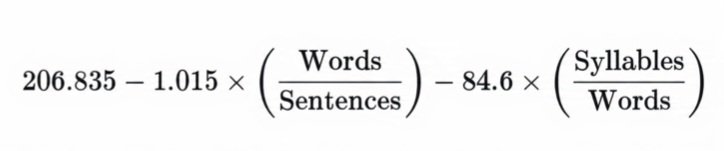
Notice that both ASL and ASW are subtracted from the base number (206.835). This means longer sentences and longer words decrease your readability scorer rating, confirming the basic principle of text clarity.
Why Readability is Crucial for SEO and UX
In the past, SEO was often about keyword stuffing and link acquisition. Today, Google’s algorithms are sophisticated, focusing heavily on User Experience (UX) and Content Quality—both of which are directly tied to readability.
Reducing Bounce Rate (The Critical UX Signal)
When a user clicks on your search result, Google monitors what happens next. If the user arrives on your page, finds the text too dense, confusing, or overwhelming, and immediately clicks the “back” button, that is a bounce.
A high bounce rate signals to Google that your content did not satisfy the user’s intent. Text clarity drastically reduces bounce rates because:
- Immediate Understanding: Users quickly find the answers they seek without having to re-read complex sentences.
- Reduced Cognitive Load: The text is easy to process, making the reading experience pleasurable, not taxing.
By using a readability scorer to simplify your content, you keep users on the page longer, sending a positive UX signal to Google.
E-A-T and Topical Authority
Google’s Quality Rater Guidelines emphasize E-A-T (Expertise, Authoritativeness, and Trustworthiness). While being an expert is crucial, that expertise must be communicated effectively.
If your expert content is so dense that only a handful of people can understand it, you risk alienating the wider audience you are trying to reach. A good readability scorer helps experts:
- Translate Jargon: Experts often use technical jargon without realizing it. The tool highlights complex words, forcing the writer to use more accessible synonyms.
- Demonstrate Authority Clearly: Communicating complex ideas with text clarity is often seen as a sign of true mastery, boosting your perceived authority.
Serving Diverse Audiences and Accessibility
The internet is global. Even if your audience speaks English, they may have English as a second or third language (ESL).
- Wider Reach: Content with a readability scorer of 60 or higher is accessible to the broadest possible audience, including international readers and those with learning disabilities.
- Accessibility Standards: Making content highly readable aligns with general web accessibility guidelines, ensuring your website is usable by everyone, which is a major ethical and SEO advantage.
Beyond Flesch-Kincaid: Other Key Formulas
While the Flesch-Kincaid index is the industry standard, it’s worth knowing that other excellent formulas exist, each focusing on slightly different linguistic characteristics. A comprehensive readability scorer often includes multiple metrics for a holistic view.
Gunning Fog Index
The Gunning Fog Index estimates the years of formal education required to understand the text. It places heavy emphasis on complex words (those with three or more syllables, excluding proper nouns and hyphenated words).
- Core Principle: This formula aggressively penalizes texts with a high percentage of “foggy” or complex vocabulary.
- Score Interpretation: A score over 12 is generally considered too difficult for a general audience.
SMOG Index (Simple Measure of Gobbledygook)
The SMOG Index is often considered one of the most accurate measures for assessing the readability of health-related documents. It is calculated by taking the square root of the number of polysyllabic words in a sample of text.
- Core Principle: It is very strict and highly accurate for predicting grade level, focusing exclusively on multi-syllable words.
- Use Case: Recommended when writing sensitive or important information where high text clarity is non-negotiable (e.g., patient information leaflets).
Automated Readability Index (ARI)
The ARI formula is designed for computer calculations and relies on character count rather than syllable count, making it easier for a readability scorer to process rapidly. It uses the following variables:
- Number of characters per word.
- Number of words per sentence.
- Core Principle: Penalizes lengthy sentences and lengthy words (measured by character length).
- Use Case: Often used for quick, automated processing in software tools.
Understanding these different formulas demonstrates the depth of your writing analysis and helps you choose the best metric for your specific audience.
Practical Tips: How to Improve Your Readability Score
Using a readability scorer is only the first step; the real work lies in improving the content based on the feedback. Here are actionable tips to boost your score immediately:
1. Conquer the Complex Sentence
Long sentences are the number one killer of text clarity. Aim for an average sentence length of 15 to 20 words.
- Strategy: When you see a sentence that is 30+ words long, read it aloud. Chances are, you are combining two or three separate ideas with conjunctions like “and,” “but,” or “because.” Break these ideas into smaller, punchier sentences.
- Bad: “The extensive research, which was conducted over the course of three fiscal years, demonstrated a notable decline in market confidence because the company failed to adapt to new technological requirements.”
- Good: “Extensive research was conducted over three years. It demonstrated a notable decline in market confidence. Why? The company failed to adapt to new technological requirements.”
2. Simplify Your Vocabulary (The Syllable Count)
The Flesch-Kincaid formula heavily penalizes words with three or more syllables (polysyllabic words). While you should never “dumb down” your content, you should actively search for simpler synonyms.
- Strategy: Check your readability scorer metrics for your ASW (Average Syllables per Word). Then, look for simpler alternatives:
- Instead of “Utilization,” use “Use.”
- Instead of “Commence,” use “Start” or “Begin.”
- Instead of “Demonstrate,” use “Show.”
- Instead of “Facilitate,” use “Help.”
3. Use Subheadings, Bullet Points, and Lists
While subheadings and lists don’t directly change the mathematical score of the Readability Scorer, they are vital for visual clarity and engagement.
- Visual Breaks: Subheadings break up long walls of text, giving the reader a mental “breather” and allowing them to scan the content quickly.
- Scannability: In the digital world, most users scan before they read. Bullet points highlight key takeaways, improving the user’s ability to extract value instantly. This indirectly improves UX signals, which positively impacts SEO.
4. Favor the Active Voice
Passive voice often requires more words to express an idea, needlessly increasing your ASL. Active voice is direct, concise, and typically requires fewer words.
- Passive: “The data was collected by the research team.” (7 words)
- Active: “The research team collected the data.” (5 words)
5. Leverage Your Readability Scorer Tool
The single best way to maintain high text clarity is to make the Readability Scorer an integrated step in your writing workflow. Do not write for an hour and then check the score; write a paragraph, check the score, and adjust immediately. This practice solidifies good writing habits over time.
Conclusion: Make Text Clarity Your Content Superpower
The modern web rewards content that is not just insightful, but instantly accessible. Ignoring your content’s complexity is like throwing away the key to your audience’s engagement.
By incorporating a Readability Scorer into your editing process, you move beyond subjective opinions about writing quality and rely on objective metrics like Flesch-Kincaid to ensure high-impact results. This simple, free tool gives you the power to reduce bounce rates, boost user experience, and ultimately, improve your content’s search rankings.
Start using a readability scorer today to transform your writing from complex jargon to clear, compelling content that truly connects with your audience.